
Thailand is no longer just a destination. It is the strategic gateway between China and Southeast Asia, and the professionals who understand how to operate inside that system are among the most sought-after talents in the region. The BBA Bilingual program is not just a degree. It is a geographic advantage.
The World's Biggest Business Shift
Is Happening Right Here
Thailand is rapidly emerging as a regional hub for clean technology, robotics, and EV manufacturing. As Chinese enterprises continue to expand their investments across the country, demand is growing for professionals who can bridge Chinese business culture and the local market. Foreign professionals in management positions at BOI-promoted companies often earn salaries starting from around 75,000 baht per month, while executive-level compensation can exceed 150,000 baht. The opportunity is real, and it is growing. The question is: who is prepared to seize it?
Not a Case Study A Real Market
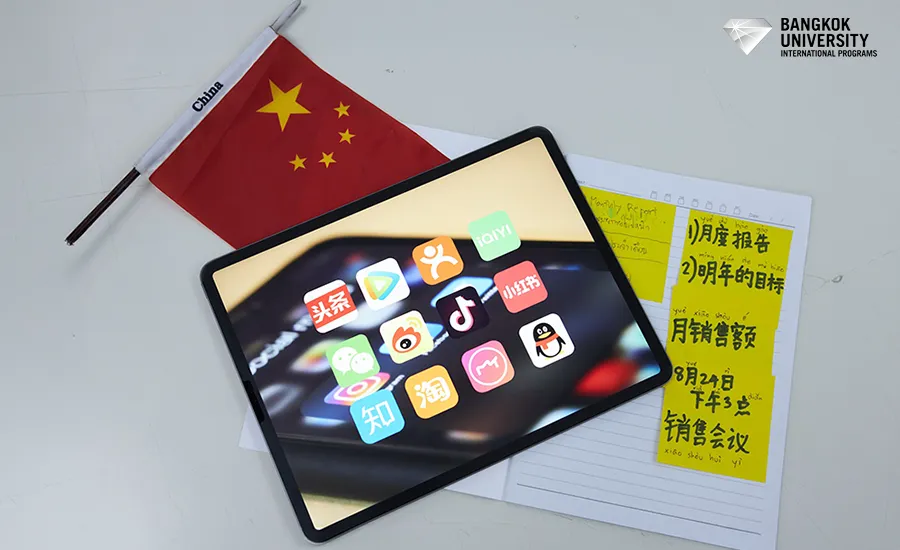
Most business programs teach through case studies. BBA Bilingual teaches through market participation. The classroom is designed as a market simulation with real stakeholders, real briefs, and real consequences. Students are not positioned as learners observing business from a distance. They are positioned as market owners and cross-border connectors who must adapt, navigate conflict, and execute. This approach, combined with project-based learning and integration of digital tools and AI, means that by graduation, students have already practiced the job they are about to start.
3 Years, 2 Languages
1 Career in the China-ASEAN Business System

The BBA Bilingual program is built around a single insight: the most valuable professionals in the China-Thailand-ASEAN corridor are not just business graduates. They are cross-border operators who think in two languages, understand two business cultures, and can execute across both markets. In 3 years, with a curriculum taught 70% in Chinese and 30% in English, across 120 credits, students build exactly that capability. The learning model is not lecture-based. It is role-based and market-simulated, placing students inside real business scenarios from Year 1 rather than asking them to wait for internship season to experience the real world.
Career That Starts Where Others Are Still Applying

BBA Bilingual graduates enter a talent market where demand consistently outpaces supply. Entry-level roles include Business Assistant, Customer Service in bilingual environments, and Startup Intern. Mid-level graduates move into Digital Marketing Trainee, HR Assistant, Junior Project Coordinator, and Business Development Support. By the professional practice year, students are positioned for Management Trainee, International Marketing Executive Trainee, Logistics Coordinator, and International Business Coordinator roles. The program's exchange student pathways and short-term programs extend the network further, giving graduates connections across the China-ASEAN region before they even begin their first job search.