


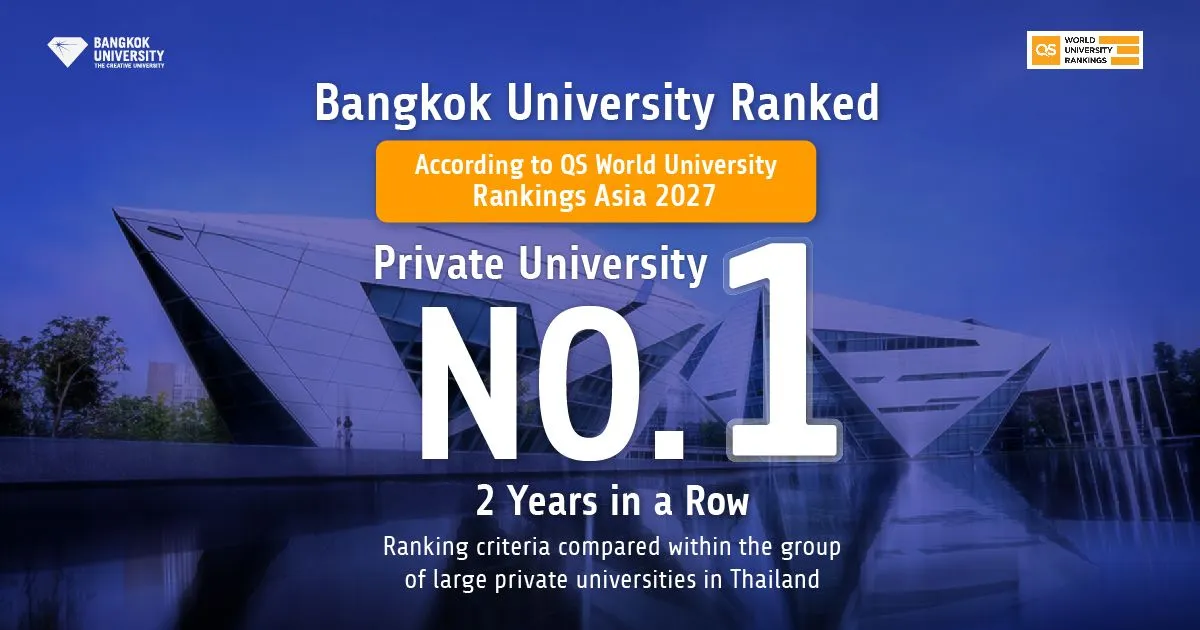
Bangkok University has been ranked No. 1 in Thailand for the 2nd year, in a comparison among large private universities (Size L and above) with more than 12,000 students, in the ranking of leading universities in Asia by QS World University Rankings, a world-renowned university ranking organization. QS announced the QS World University Rankings: Asia 2027 on November 4, 2026 (B.E. 2569), covering more than 1,725 ranked universities across Asia.

The QS World University Rankings: Asia evaluates and ranks universities in the Asian region using 11 performance indicators. Each indicator carries a different weighting according to its importance, covering reputation and academic recognition, research output and publication, teaching quality and staff, and internationalization and exchange. The indicators fall into 4 main categories:

Reputation and Recognition is an important component in assessing a university’s quality and image. It has 2 indicators:
- Academic Reputation (30%): assessed from a survey of academics and experts worldwide.
- Employer Reputation (20%): based on a survey of managers and recruiters about the quality of the university’s graduates.

Research and Academic Output reflects the potential and quality of research production and its impact in academia:
- International Research Network (10%): measures the diversity of international research collaboration.
- Citations per Paper (10%): measures the quality and impact of research cited in the Scopus database.
- Papers per Faculty (5%): reflects the rate of academic output by faculty members.

Teaching Quality and Staff considers readiness for teaching and the academic qualifications of faculty. It has 2 indicators:
- Faculty / Student Ratio (10%): assesses readiness to support students and the teaching-to-student ratio.
- Staff with a PhD (5%): measures the academic qualification level of faculty.

Internationalization and Exchange assesses a university’s ability to create an environment open to cultural diversity and international exchange. It has 4 indicators, each weighted equally at 2.5%:
- International Faculty Ratio: the proportion of staff from abroad.
- International Student Ratio: the proportion of students from abroad.
- Inbound Exchange Students: the proportion of students coming in on exchange.
- Outbound Exchange Students: the proportion of students going abroad on exchange.

The QS World University Rankings: Asia 2027 therefore evaluates universities across many dimensions: academic reputation and employer recognition, research capability and publication, teaching quality and staff, and internationalization and exchange. Each indicator has a clearly defined weighting used as the criteria for evaluating and ranking universities in the Asian region.





Information
Register Info
Contact Us